
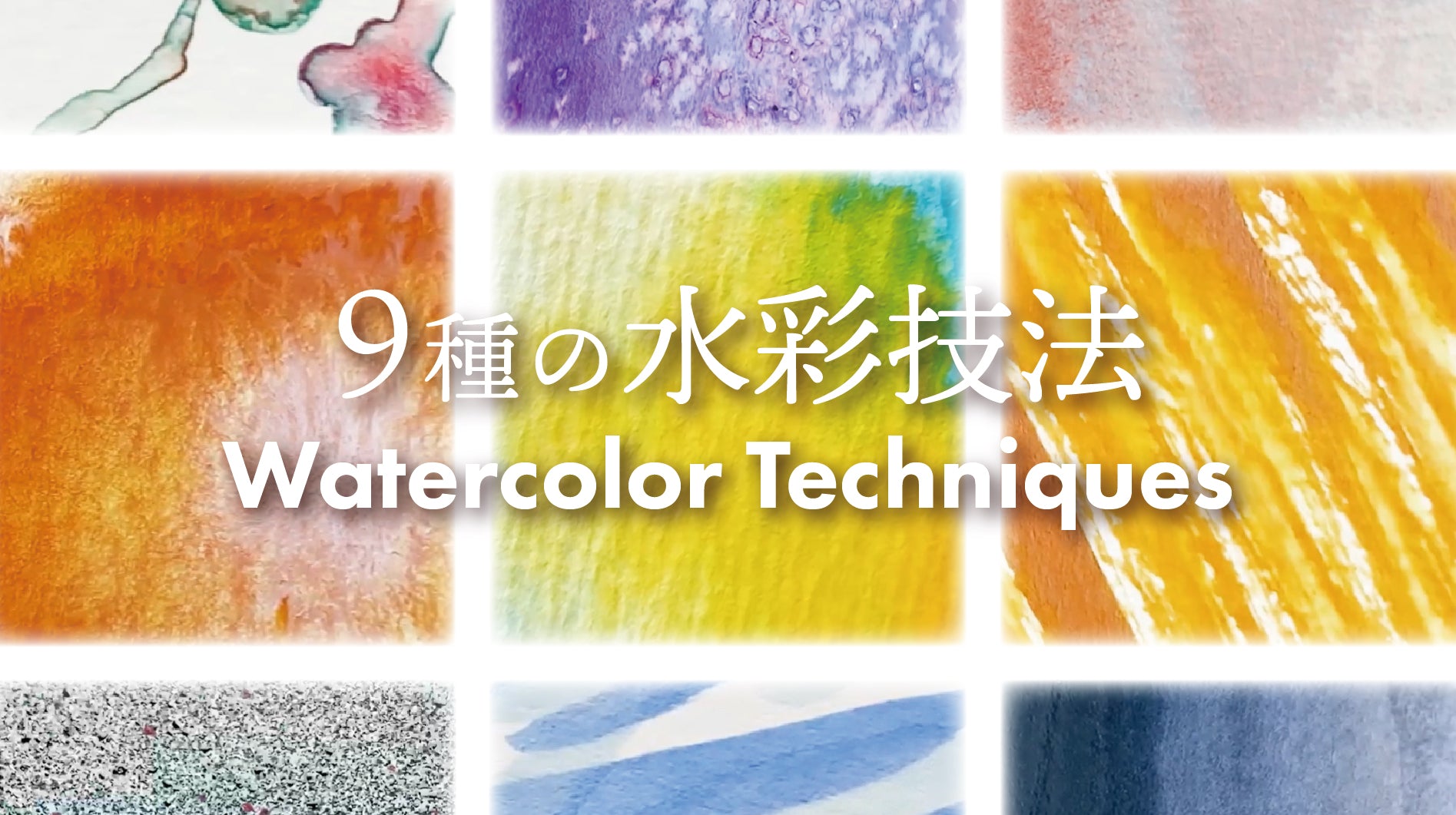
Introducing 9 Watercolor Techniques!
Watercolor painting is an easy and fun way to express yourself using watercolors or water-based dye pens and inks.
By utilizing various techniques, you can achieve a wider range of expressions.
We will introduce each technique with a video. We hope this will be useful for your creative activities!
*Click on the image of each technique for more details.
 |
 |
 |
 |
 |
 |
 |
 |
 |
Dripping
"Dripping" is a technique where paint dissolved in a generous amount of water is dripped onto paper. It's perfect for creating abstract art as it easily produces modern patterns!
【Materials Used】Kuretake Gansai Tambi Granulating Colors 5-color set
▼STEP 1
Dissolve Gansai with a generous amount of water.
▼STEP 2
Pick up the dissolved Gansai with a brush or water brush pen and drip it onto the paper.
▼STEP 3
Blow air through a straw or similar object onto the dripped Gansai to create a pattern.
Salt Technique
The "Salt Technique" is a method that uses salt, as the name suggests. When salt is sprinkled on paper that is still damp, beautiful patterns like snowflakes emerge.
【Materials Used】Kuretake Gansai Tambi Granulating Colors 5-color set
▼STEP 1
Paint the background.
▼STEP 2
Blend the background with a water brush pen to create a gradient.
▼STEP 3
Sprinkle a small amount of salt while the background is still wet.
▼STEP 4
Leave the paper to dry, and unique patterns will emerge.
Lift Out
"Lift Out" is a technique where applied paint is lifted and removed. It is often used to express leaf veins or clouds.
【Materials Used】Kuretake Gansai Tambi Granulating Colors 5-color set
▼STEP 1
Paint the background to create a gradient.
▼STEP 2
Before it dries, use soft paper like tissue paper to blot the paint.
▼STEP 3
If the color doesn't lift much, add more water to the area you want to lift with a water brush pen, and then blot again.
Backruns
"Backruns" is a technique that utilizes the backflow of water to create cauliflower-like patterns. The patterns produced vary greatly depending on the paper and the amount of water used!
【Materials Used】ink-café Art Nouveau Color Ink
▼STEP 1
Use ink to paint the background. A gradient finish also looks beautiful.
▼STEP 2
While the background is semi-dry, pick up plenty of water-infused Gansai with a water brush pen and gently touch the tip to the paper. The "Water Brush Pen Menso Small" is ideal for backruns because its fine tip holds water well!
▼STEP 3
Wait for the pattern to spread naturally.
Wet on Wet
"Wet on Wet" is a technique where colors are applied to wet paper or into colors that are still wet. The way the colors bleed varies depending on the amount of water and the type of paper, creating different expressions. It is suitable for backgrounds and depicting skies.
【Materials Used】Kuretake Gansai Tambi, Water Brush Pen
▼STEP 1
Apply water to the paper. Apply Gansai color as if placing it.
▼STEP 2
Apply another color before it dries. Enjoy the different ways the colors bleed.
Dry Brush
"Dry brush" is a technique where paint is applied with a brush that has very little water. It is used in various situations, such as depicting grass or waves by utilizing the dry, streaky brushstrokes.
【Materials Used】Kuretake Gansai Tambi, Water Brush Pen Menso Small/Large
▼STEP 1
Apply color by moving the brush tip quickly back and forth.
▼STEP 2
Layering different colors adds depth.
Spattering
"Spattering" is a technique of splashing ink or paint. Its reliance on chance adds an accent to the artwork.
【Materials Used】ink-café Meiji Colors
▼STEP 1
Pour plenty of ink into a palette or paint dish.
▼STEP 2
Pick up the ink from STEP 1 with a brush that contains an appropriate amount of water.
▼STEP 3
Rub the brush against a fine-mesh screen to splatter ink onto the paper.
If you don't have a spattering screen or brush, you can use a colander or toothbrush as a substitute.
Glazing
"Glazing" is a technique of layering the same or different colors while maintaining transparency to create depth. It can easily express overlapping flower petals and is also useful for creating small message cards!
【Materials Used】ZIG Clean Color Real Brush
▼STEP 1
Start by applying darker colors.
▼STEP 2
The key is to let it dry completely before applying the next color!
▼STEP 3
After drying, layer the colors without disturbing the outline of the underlying color.
Gradation
"Gradation" is a technique of smoothly blending shades, often used in landscape paintings for skies and seas.
【Materials Used】Kuretake Gansai Tambi SUMI COLORS 6-color set
▼STEP 1
Apply darker colors first.
▼STEP 2
Before the dark color dries, apply lighter colors so they overlap.
▼STEP 3
Blend the borders to create a beautiful gradation.
Whether you are familiar with watercolors or just starting, please try Kuretake's watercolor art supplies!
Related Products
The separation and bleeding of colors vary depending on the type of paper. Dissolve with plenty of water, and then draw after the colors separate in the palette to enjoy more color changes. This was used for dripping, salt technique, and lift-out techniques.

Its unique characteristic is the profound color created by the combination of soot and pigment, reminiscent of sumi ink. By adjusting the amount of water, a wide range of expressions can be achieved, from rich, lustrous colors to delicate, beautiful hues.
《Limited edition overseas-exclusive products now available at Kuretake's official online shop》

A new Menso brush type for water brush pens is now available! There are two types: "Menso Small" with elastic bristles that can draw both thick and thin lines, and "Menso Large" with firm bristles convenient for drawing fine lines.

Menso Small

Menso Large
A brush-type color brush pen. Easily enjoy watercolor art and lettering with vibrant colors. 180 colors available.

The "Art Nouveau Color Inks" are color inks inspired by the popular color lithographs of the Meiji era, around the time Kuretake was founded, reflecting the fashionable colors of that period.

The "Meiji Colors" are color inks inspired by the fashionable colors of the Meiji era, evoking a sense of that period.

※The content of the article reflects information at the time of publication and may differ from the latest information.