
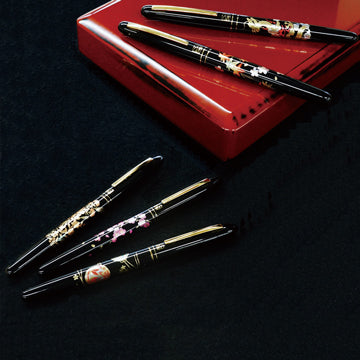
On January 30, 2019, Kuretake Co., Ltd. released five new designs for its "Mannen Mouhitsu Makie Monogatari" and "Tegami Pen Makie Monogatari" series. They are available at stationery stores, mass merchandisers, and souvenir shops nationwide.
Makie Monogatari is a series of brush pens and letter pens whose barrels are decorated with makie, a traditional Japanese craft. We will introduce their exquisite and beautiful designs.
Autumn Breath
The most prominent feature of Kuretake's Makie Monogatari is, above all, the beauty of its gold. Its dazzling brilliance is indescribably beautiful. The three-dimensional effect unique to makie further enhances its appeal. "Autumn Breath" generously uses this gold, and it can be said that it embodies the unrivaled quality of Kuretake's Makie Monogatari. The exquisite graduation from green to gold in the accentuating grass leaves is also a masterpiece that we encourage you to experience firsthand. The elegant gold-based design is sure to please both men and women.
Cherry Blossom Spring Breeze
Cherry blossoms, the heart of the Japanese people. As a flower symbolizing Japan, and as Ariwara no Narihira once wrote, "If there were no cherry blossoms in the world, the heart of spring would be peaceful," cherry blossoms are an inseparable part of Japanese life and culture. Only the Japanese people eagerly await the blooming of cherry blossoms in spring after the snow melts and regret their falling.
The cherry blossoms depicted in makie this time are a bright and lovely pink, and are sure to be enjoyed by everyone from young women to the elderly. The cherry blossom, symbolizing Japan, is also ideal as a souvenir. It is an item that will be appreciated both domestically and internationally.
Ball Play
"Temari" are made by winding elastic cotton threads into beautiful geometric patterns. During the mid-Edo period, "mari-asobi," playing with these temari by bouncing or throwing them, was particularly popular. Today, temari have become traditional crafts, cherished as decorative items. This product precisely expresses these intricate geometric patterns through makie, accented with soft green and eye-catching artisan-crafted red colors. This product, featuring temari, which are beloved as decorative items, on a pen barrel, will surely add a vibrant touch to your desk.
Cherry Blossoms and Autumn Leaves
Cherry blossoms and autumn leaves. It is impossible to see these two at once in Japan, which has such distinct seasons. This so-called "spring and autumn" pattern depicts an "imaginary season" where both spring cherry blossoms and autumn leaves exist, so it does not belong to any single season and can be used year-round. You often see it in kimono patterns, don't you? In tea ceremony tools, there is also a " Unkin pattern." The Unkin pattern is a colored design with full-blooming cherry blossoms and autumn leaves, where "Un" in Unkin represents cherry blossoms with white clouds, and "Kin" represents autumn leaves with brocade. In this way, the pattern of cherry blossoms and autumn leaves has continued to live on in Japanese tradition and culture. Why not add this item, adorned with cherry blossoms and autumn leaves, which are deeply rooted in the lives of Japanese people who appreciate nature and pay attention to seasonal changes, to your collection?
Dragon and Hoju (Sacred Jewel)
Surely every boy has yearned for it at least once. Dragons have been revered and loved for 4,000 years in China as auspicious symbols and objects of awe. (※Note 1)
The dragon depicted in makie this time has three claws. Perhaps out of fear of the emperor's power, dragons in Japanese art often have three claws. We adopted the more familiar dragon in Japan, so the dragon on this product has three claws. The dragon, with its slightly endearing face, is a masterpiece that will be widely appreciated by men. Furthermore, its meticulously depicted scales and the supple movement of its body are beautiful to behold every time, and will surely delight the user. Why not give this ascending dragon, aiming high and embodying wishes for good fortune, career advancement, and business development and success, to someone special?
Recommendation for "Mannen Mouhitsu" with an authentic writing feel
 "Mannen Mouhitsu Makie Monogatari" uses polyester brush material that has the same properties as weasel hair (※Note 2). For those who are comfortable with brush writing, it would be a literary companion for everyday use.
It comes in a Paulownia wood box, making it suitable for gifting, and includes three spare ink cartridges, so it can be enjoyed for a long time. Even if the included spare ink runs out, it can be purchased separately.

↑A high-quality Paulownia wood box with a "Kuretake" seal.


↑Separately sold "Brush Pen Spare Ink Pigment / 3-piece set" ¥200 (tax excluded)
"Tegami Pen" allows you to write beautifully with ease
 On the other hand, the "Tegami Pen Makie Monogatari" uses an extra-fine hard-tip brush pen that allows you to write beautiful Japanese characters with the ease of a pen.
By simply varying the pressure, you can easily create thick and thin lines, as well as stops, flicks, and sweeps, just like with a brush. This means even those who are not confident with brush pens or brush calligraphy can easily write "beautiful characters." As the name "Tegami Pen" suggests, it is especially useful for writing letters where you want to convey your feelings with meticulous handwriting. Of course, for everyday use in memos and notebooks, you'll feel better writing with slightly neater characters than usual.
This also comes in a paper box, ideal for gifting. Even if the ink in the included Tegami Pen runs out, it can be replaced with a separately sold refill ink. The set refill is extra-fine black, but extra-fine refill inks are available in four colors. Ballpoint pen and brush pen refills (both in black only) are also available, so you can switch them according to your needs.

↑A chic paper box with a pleasant texture.

↑6 types of refills. Extra fine and ballpoint are ¥200 (tax excluded), brush pen is ¥300 (tax excluded).
If buying for yourself, imagine the scene of use; if for a gift, think of the recipient, and choose the perfect item.
Product Information

Kuretake Mannen Mouhitsu Makie Monogatari
Product number: See list
Release date: January 30, 2019 (already released)
Price: 5,000 yen (tax excluded)
| Product Name | Color/Type | Product Number | JAN |
|---|---|---|---|
| Kuretake Mannen Mouhitsu Makie Monogatari | Autumn Breath Black | DU185-215 | 4901427304824 |
| Kuretake Mannen Mouhitsu Makie Monogatari | Cherry Blossom Spring Breeze Black | DU185-315 | 4901427304831 |
| Kuretake Mannen Mouhitsu Makie Monogatari | Ball Play Black | DU185-415 | 4901427304848 |
| Kuretake Mannen Mouhitsu Makie Monogatari | Cherry Blossoms and Autumn Leaves Black | DU185-515 | 4901427304855 |
| Kuretake Mannen Mouhitsu Makie Monogatari | Dragon and Hoju Black | DU185-615 | 4901427304862 |
Kuretake Tegami Pen Makie Monogatari
Product number: See list
Release date: January 30, 2019 (already released)
Price: 3,000 yen (tax excluded)
| Product Name | Color/Type | Product Number | JAN |
|---|---|---|---|
| Kuretake Tegami Pen Makie Monogatari | Autumn Breath Black | ER191-210 | 4901427304879 |
| Kuretake Tegami Pen Makie Monogatari | Cherry Blossom Spring Breeze Black | ER191-310 | 4901427304886 |
| Kuretake Tegami Pen Makie Monogatari | Ball Play Black | ER191-410 | 4901427304893 |
| Kuretake Tegami Pen Makie Monogatari | Cherry Blossoms and Autumn Leaves Black | ER191-510 | 4901427304909 |
| Kuretake Tegami Pen Makie Monogatari | Dragon and Hoju Black | ER191-610 | 4901427304916 |
※Note 1 About Dragons
Dragons are imaginary creatures that originated in China. The character for dragon can be seen in oracle bone script used during the Shang Dynasty (from around the 17th century BC to the 11th century BC) and in bronze inscriptions from the subsequent Zhou Dynasty, demonstrating how long the Chinese people have been associated with dragons.
The book "Huainanzi" from the late 2nd century BC mentions four types of dragons: Feilong (flying dragon), Yinglong (responding dragon), Jiaolong (aquatic dragon), and Xianlong (preceding dragon), from which birds, beasts, fish, and crustaceans were born, respectively. This means that dragons were the ancestors of all animals, a god-like being that created all things.
However, the dragon, which should have roamed the skies freely, was captured by the emperor's power and confined within his robes. From this time on, the dragon became the symbol of the emperor as a powerful ruler.
On the robes worn by emperors during the most important ceremonies, there were twelve patterns called "Twelve Ornaments" that symbolized the virtues a ruler should possess. One of these was the dragon pattern. This symbolized that just as a dragon transforms, a ruler should also govern flexibly according to the times. Since the Twelve Ornaments are said to have been established during the time of the ancient sage-king Shun, dragon patterns existed from a very early period, but at that time, the dragon was not yet a symbol of power.
During the Tang Dynasty, dragons began to adorn the emperor's clothes as a symbol of power. In the 3rd year of Changshou, high-ranking officials were granted robes with dragon patterns. Receiving a dragon robe, a symbol of power from the emperor, was a great honor. Eventually, people began to wear dragon-patterned clothing without authorization. In the 1st year of Dade, it was deemed permissible to have small dragon patterns on the chest and back, but wearing large dragons that covered the entire garment was prohibited. In the 2nd year of Yanyou (1315), the five-clawed, two-horned dragon pattern was stipulated as exclusively for the emperor. Thus, a dragon with five claws and two horns on its head became established as a symbol of power.
https://www.kyohaku.go.jp/jp/dictio/senshoku/48koutei.html
※Note 2 Weasel hair

Weasel hair is hair taken from the tail of a weasel. It is highly valued because it is elastic throughout the entire hair. It is also a brush material with a fine and well-defined tip.
※The content published in the press release is information at the time of announcement and may differ from the latest information.